
Less developed country method helps Danish eye patients
Advanced low-tech MSIC technique for advanced cataracts in developing countries can also be used at Rigshospitalet/Glostrup
The history of cataracts
Cataracts have been known for several thousand years. The earliest surgical technique was so-called couching, in which the "coucher" pierced the conjunctiva with a pointed instrument and pushed the white or brown/black lens away from the pupil so that more light could enter.
However, such an operation carried great risks, often causing retinal detachment, bleeding and infections that left the patient completely blind. The eye patch had to stay on for a week, and by then the coucher had moved on, out of reach. The most notorious coucher in Europe was John Taylor in the 18th century, who also treated Johann Sebastian Bach, who ended up completely blind.
Cataract surgery in modern times
After couching came several different, safer surgical methods, in which the eye was opened 180 degrees to remove the lens, after which a number of sutures were placed to keep the eye watertight. Patients were admitted to hospital and the eye patch had to stay on for many days.
In 1987 the new ultrasound technique was introduced in Denmark with the phacoemulsification machine. Through a small incision, a tunnel about 3 mm wide is opened, and with a phaco probe (phakos, Greek for lens) the lens is broken up, aspirated, and a new foldable lens is placed in the capsular bag. This method is safe and is used for most cataract patients in the world, and the incisions are self-sealing. With extremely hard cataracts, which we still see from time to time here in Denmark, a great deal of extra ultrasound energy is needed, which often causes complications (a dropped nucleus due to a tear in the posterior capsule, and corneal oedema due to damaged endothelial cells). In these cases the old technique sometimes has to be used, where the lens is removed whole and the incision has to be closed with sutures.
MSIC – Manual Small Incision Cataract Surgery
There is, however, a solution: another surgical method for dark brown, hard cataracts, MSIC (Manual Small Incision Cataract Surgery), was developed precisely for this. Ultrasound machines are expensive to buy and maintain and require special, expensive handpieces and disposables, which is why this method has not been used in countries with few resources. Having been on a cataract surgery mission to developing countries almost every year for the last 14 years, I learned a new technique from Dr. Bidya in Dhangadhi, Nepal, back in 2013. Before then, my team travelled with smaller phaco machines, but there was often a problem getting the machine through customs (corruption), which delayed us, sometimes for several days. As a result, we could not operate on the number of patients we had planned for. In addition, most patients had very dark brown, dense cataracts that were difficult to remove with phaco/ultrasound, and complications could arise that were hard to treat because of a lack of equipment and expertise locally.
The MSICS technique is not very resource-intensive and is now widely used in developing countries. In the hands of an experienced surgeon, the technique is just as fast as ultrasound surgery.
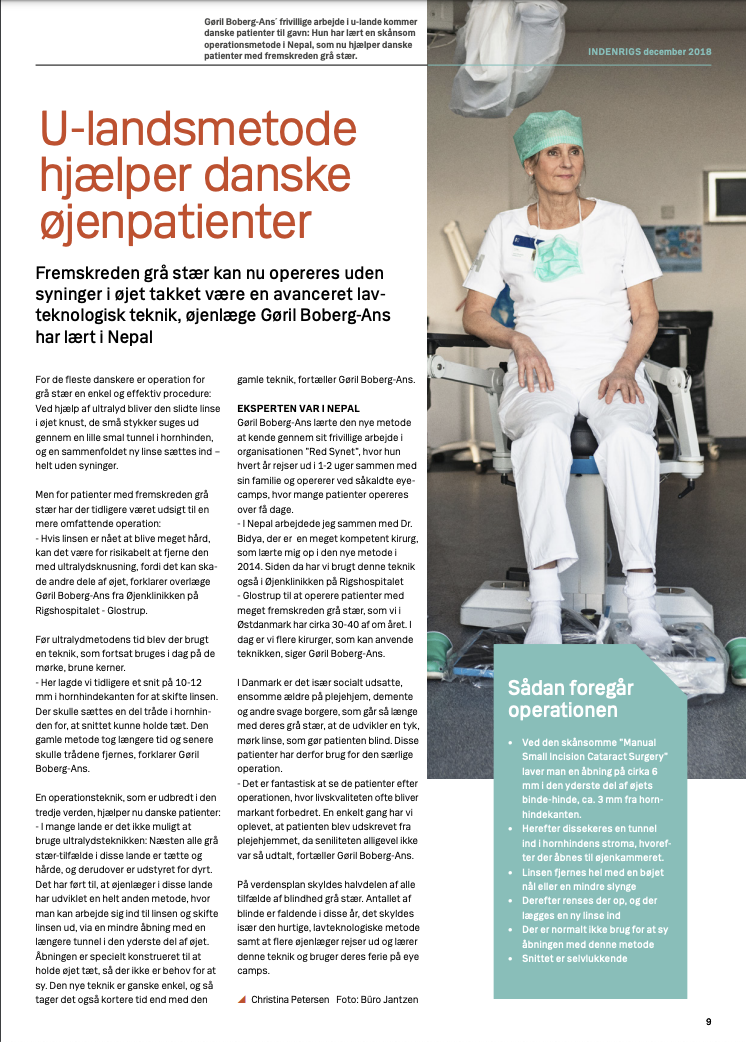
The technique involves making an incision of about 6 mm at the outer opening in the conjunctiva and widening the inner opening of the incision to about 10 mm intracamerally/inside the eye. The lens can then be removed whole with a bent needle or a small loop, the area is cleaned, and a new lens is placed in the empty capsular bag. The incision usually requires no sutures, as it is self-sealing thanks to the long intrascleral tunnel.
The cornea is usually only slightly affected the day after, and the risk of losing the lens into the back of the eye is minimal.
On our trips to developing countries, we have arranged for a team of competent volunteer eye surgeons and experienced local eye assistants to pre-screen the patients. Flyers or similar are sent out to announce that an eye camp is taking place. Patients often walk for days with their families, some are carried on someone's back, and the family often comes along with their livestock. Using a torch, the assistants can see whether there are advanced cataracts in both eyes from the absence of a red reflex in the pupil. The patients then have one eye operated on, so that we can help more people.
There is a big difference between being blind in both eyes and seeing with one eye. We spend about 1.5 weeks of holiday a year and, with 2 surgeons, can perform about 100 operations over 5 days of surgery. The rest of the time is spent setting up the operating room, pre- and post-operative check-ups and transport. It makes a huge difference to their lives. Grandchildren can go back to school, because they no longer have to look after grandfather all day. The patients themselves can go back to work or help out.
There are about 44 million blind people worldwide, and half of them are blind because of cataracts. This number is now falling thanks to more aid organisations and the new MSICS method, which is becoming more and more widespread. The method is safe and cheap, as it does not require high-tech equipment.
The MSICS method also at Glostrup
In Denmark, too, we have patients who do not see an ophthalmologist in time, especially people with dementia, people living alone and socially vulnerable people. Some come with very dense, dark brown cataracts that can be difficult to remove with phacoemulsification. Since 2014, around 200 patients have benefited from the MSICS method at the eye department in Glostrup. It is wonderful to see these patients, whose quality of life is often markedly improved, and on one occasion we saw a patient discharged from a nursing home because the senility turned out not to be so pronounced after all.
By Gøril Boberg-Ans
Consultant, Clinical Associate Professor, Department of Ophthalmology, Glostrup