With a vision for the third world
Giving is the greatest gift! We are happy to share it with others.
The sharing economy is the new mantra – shared education is the new vision!
- Dr. Jannik Boberg Ans
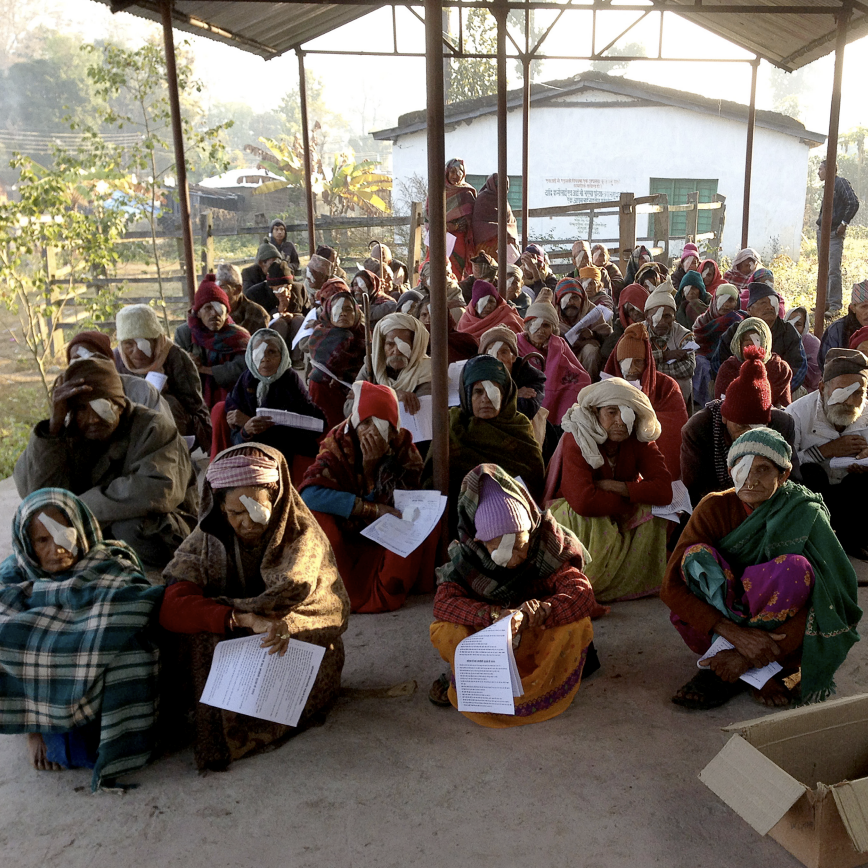
Being able to help developing countries reduce their widespread so-called 'preventable blindness' is a gift that every ophthalmologist has the opportunity to give. But only very few experience this side of the ophthalmologist's work.
In countries with a shortage of doctors, poverty and malnutrition, there are many blind and visually impaired people because of diseases that – given access to health care – could easily have been treated. Egyptian eye inflammation (trachoma) is thus very widespread in subtropical and tropical areas, where hygiene, access to antibiotics and surgery for misdirected eyelashes could prevent the cornea from becoming clouded. Similarly, the consequences of injuries followed by infections can lead to blindness. On top of this comes the most common cause of blindness: cataracts. In the big cities of poor countries, the few surgically trained ophthalmologists charge for cataract surgery. In the outlying areas, on the other hand, there are no ophthalmologists at all, so many patients are left with no treatment available. Occasionally the family can save up for grandfather's operation and even arrange transport to the city, but the majority never get the offer.
Here in Denmark, a cataract rarely becomes very dense before cataract surgery is offered through the system, although there are cases where socially vulnerable patients in particular come to surgery late. We also know it from our own Commonwealth of the Realm, where, for example, Greenlandic cataracts can become white and dense before surgery can be offered, because of geographical distances and other infrastructure.
Greenland first
In this respect, Greenland became a revelation to us. In 2000, Rigshospitalet was looking for surgeons to serve Qaqortoq in March, and as it turned out to be possible for both me and my wife Gøril to coordinate some holiday and leave, it became our first test of operating in unfamiliar surroundings and under different skies. Our two children were enrolled in the local Greenlandic school, with March temperatures down to -35 degrees. Partly for that reason, we sometimes had to wait for the patients; sometimes we had to sail out ourselves and fetch them in a slightly larger boat, when their own small boats made the trip from settlement to hospital too dangerous.
Many of the patients could only perceive hand movements and light, and their lives were completely changed by the cataract operation. Here we experienced the light of joy in their eyes, but also the joy expressed in the whole face and body when the patch was removed. Their sight was restored, and they could go to sea again, fish, hunt and take out the kayak. – As down in Denmark, we operated with the extracapsular technique and ultrasound fragmentation of the lens nucleus with phaco. We also performed a few acute iris valves (iridectomies) and drainage operations (trabeculectomies) where there was high eye pressure.
A year later we had to go up there again, and once more with the children in the local school. After school they helped out at the hospital in the afternoons, and it became a family experience. The children gained insight into our work and could probably also sense the joy of helping and caring. The flight was nearly cancelled because of the terror date 9-11-2001. – Once again it was fantastic not just to be a tourist, but to really feel part of the local community. A completely different way of experiencing a different culture and population.
Nepal – and the rest of the world.
With all this in our baggage, we soon found that there were other organisations looking for eye surgeons (SEE - Surgical Eye Expeditions, Vision Outreach and others). The Norwegian ophthalmologist Dag Riise spoke inspiringly about his work in Nepal, where he was not only operating and building up a decentralised eye hospital service, but was also supporting a talented young local man in becoming a doctor and ophthalmologist. With Norwegian support organisations behind them, Ruth and Dag Riise paid for the young man's education in Russia. And after being away from his family for almost 10 years, Bidya Prassad Pant returned and took over the running of Dhangadhi, Geta Eye Hospital. This happened with continued support from Ruth and Dag Riise, who both often visited the hospital and worked there.
SEE invited us to Peru, together with ophthalmologist Peter Vangsted, who already had several trips with the organisation behind him. Later came activities in the Dominican Republic, Lesotho, Nepal and Myanmar. In the first years we spent a lot of energy on setting up ultrasound equipment (phaco), so that in addition to traditional extracapsular operations we could also do phaco. But this heavy logistics, added to the transport of microscopes, lenses and instruments, was impractical, and we had to rethink the planning.
The surgical method MSICS (Manual Small Incision Cataract Surgery is very effective. Several studies have shown it to be just as effective and safe, and with results just as good as 'Western' phaco. We therefore had to learn this technique properly, and Dag Riise helped us with contacts and an invitation to the hospital in Nepal, where Dr. Bidya was in charge of the training. He welcomed us warmly when Peter Vangsted, Gøril and I visited the clinic in Dhangadhi and the eye camp in Jogbuda at the foot of the Himalayas. We acquired the MSICS technique, although there is still some way to go before we, like Dr. Bidya, can perform 100-300 operations per day. It has been a great pleasure to have Dr. Bidya as a close friend and a beloved, respected colleague, and we have since shared much of our spare time with him.
Primitive conditions in the field
Working with MSICS brought unfamiliar challenges. Operating chairs were often wooden crates, and operating tables were often ordinary dining tables with a microscope strapped on. All in all a good experience, despite aching backs and necks and a sore bottom. You discover that it is not the advanced chairs and ceiling-mounted electronic xy-coupled microscopes alone that make the difference. With a bent cannula you can in fact perform an equally fine sutureless operation with lens extraction and an artificial lens implanted, even without access to all the modern equipment and technical accessories.
It is also thought-provoking that, by focusing on the patients' actual circumstances, we could work so well and safely in the third-world clinics, even without the latest IT and accrediting quality assurance – provided, of course, that the work was organised to suit the conditions. For all patients, Dr. Bidya performs a medical history, blood pressure, diabetes screening, HIV and hepatitis tests, safe surgery and follow-up care, all with completely simple manual record-keeping. On our last trip to Taunggyi, Myanmar, we could treat a patient, lens included, at a cost of less than 15 $ per operation, and at the follow-up examination of all 269 patients in Myanmar, no later than 3 months after the procedure, no complications had occurred.
Technical learning both ways.
These experiences cannot and should not be transferred one-to-one to our latitudes, but it is thought-provoking how simply and safely it can be done. One thing, however, we have brought home with us from the MSICS technique. We both use this method for hard lenses, which with advanced phaco would otherwise require a high use of ultrasound and a greater risk of both corneal oedema and a dropped lens nucleus. The latter especially when dark brown cataracts are present.
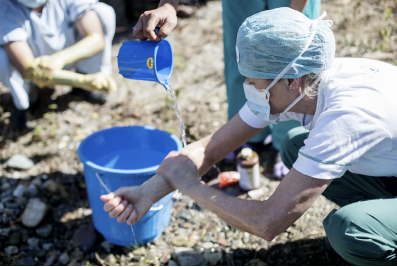
It has been instructive to see how the pre-examination of 150 patients at 2 slit lamps is organised in a few hours, and how 100 patients are efficiently checked late in the afternoon. How the patients are washed and prepared, how local anaesthetic is injected behind the eye (retrobulbar anaesthesia) on a production line, without the patients showing signs of any major discomfort or pain. How to operate on two tables at the same time, with just one operating microscope in the middle. How the assistant finishes one operation and starts the next, with the holding suture and all the preliminaries. How to bend a 21 g cannula into a hook, so that it works perfectly as the instrument for extracting a lens nucleus, with due support from viscoelastic substances and without the use of advanced 'Western' high-tech handpieces. The chamber and capsular bag are cleaned manually with suction and irrigation through a Simco cannula, and without warning sounds if you should accidentally have sucked onto the capsule. Finally, the plastic lens is inserted. Watch the video MSICS in Geta Eye Hospital, Nepal by Dr Bidya Pant
The local organisation
Not everything is cataracts. You also learn operations for trichiasis, assessment and diagnosis of exotic diseases, and combined glaucoma and cataract operations, where lowering the pressure with eye drops afterwards cannot always be relied on, i.e. once the patient returns to the village. You can easily feel alone with difficult cases. But the future will certainly bring knowledge-sharing via the internet, ideally based on photographs. With medical students and nurses from outside as assistants, including our now grown-up children, considerable experience in clinical situations is gained. It has been a particularly fantastic experience to be able to work professionally with one's spouse, colleague and children under such unfamiliar conditions.
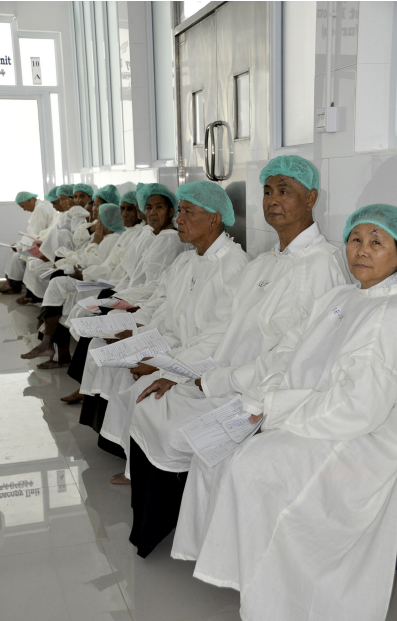
One must also admire the locally trained staff, who with such great efficiency and empathy treat and guide the many patients through the large machinery – here in well-functioning eye camps with between 50 and 100 operations a day. A good experience, with the primary focus on the patient and the core task. All this in some contrast to the Western world, where more than 50 % of resources and concentration are now spent on registration, including entering negative findings and documenting legal and quality-assurance considerations – what might be called defensive record-keeping. You have to document patient identification and use copy-paste stereotypes that do not always cover the actual situation. I cannot help remembering the eye camp's little record book, which captures so much – including the patient's consent and a fingerprint. A different world, yes, and both worlds have their advantages and disadvantages, but feeling the contrasts is enriching and exhilarating. You can actually take good things with you in both directions.
Support from the rich countries
Fortunately, we are not the only ophthalmologists who have worked on aid projects and eye surgery abroad. At the risk of forgetting some, I would like to mention the following colleagues: Niels Kalstrup, Anders H. Simonsen, Birger Bro Christensen, Peter Vangsted, Anders Hansen, Michael Kjær Hansen and Allan Storr Paulsen. Presumably others have also worked with SEE Surgical Eye Expeditions,Orbis and hospital ships around the globe. It has served as excellent PR for Danish ophthalmologists and has also helped a great many people to a new life with restored sight. Taking on a global responsibility could well become even greater. At the hospitals we currently work with through Dr. Bidya Pant in Myanmar, treatment is free. Today the 3 clinics Htse Saung, Taunggyi and Wakeda (supported by, among others, the SEVA Foundation, an American aid organisation) perform 22,000 operations a year, or more than 1/4 of all cataract operations performed in the country.
Eye Rescue
We are happy to work for free, but only through financial support and local income can such efforts be sustained. All too often you see well-meaning initiatives that run out of donations, and even where everything was working well, staff disappear when the finances decline. Through our newly founded aid association Red Synet (Eye Rescue), the vision is to create a more long-term effort in selected places in the third world, where permanent treatment services – preferably free of charge – can be built up through fixed aid programmes and the collection of equipment. At the same time, this can serve as training for both local and visiting ophthalmologists and support staff. Within a stay of 1-3 months, surgeons and assistants can thus be trained to carry out screening, pre-examination, follow-up and treatment, with due regard for local conditions. Danish departments could also take part more broadly through educational rotation programmes, and contribute to a wider outlook, professional flexibility and global solidarity.
In short: A new view of the world!
From the book: Øjenfagets Udvikling (The Development of Ophthalmology), Chapter 7, Red Synet. Edited by Hans C. Fledelius, Martin O. Jensen, Eva Ottovay and Thomas Rosenberg, publication supported by the Velux Foundation, 1st edition, 1st printing 2018.